Recovery · September 2026 · ten-minute read
Non-sleep deep rest, what the studies say and what they do not
A guided, eyes-closed rest practice has become one of the most widely repeated techniques in popular health conversation. The research behind it is real, recent and worth reading closely, and it says considerably less than the enthusiasm around it suggests.
Written by River Arts Observatory · September 2026

A ten-minute audio recording, a still body lying flat on a mat or a bed, closed eyes, a low and unhurried voice guiding attention slowly through breath and bodily sensation without ever asking the listener to fall asleep. The practice now widely marketed as non-sleep deep rest has spread quickly through podcasts, apps and workplace health programmes, usually accompanied by confident claims about what it does to the brain: "dopamine restored", "cortisol reset", hours of sleep debt repaid in minutes. Reading the actual trials behind it tells a smaller, more careful story than most of that packaging suggests.
This article exists because the gap between the claims in wide circulation and the evidence that actually supports them is one of the clearer examples of a pattern the Observatory watches for across this whole field: a genuinely promising early finding, in a small study, travelling a long distance through popular retelling before arriving as a confident, oversized claim. The underlying research deserves a fair reading either way, which means neither dismissing it nor inflating it.
A popularised term with a research base smaller than its popularity suggests
The term itself is recent, coined by a neuroscientist to describe a family of practices that substantially overlaps with yoga nidra, a much older guided relaxation tradition with roots stretching back well over a century, and with self-guided hypnosis protocols studied under other names for decades. This matters because the branded term arrived after much of its supporting evidence, meaning some of what gets cited in its support was originally studying a related but not identical practice, under a different name, in a different population. That is not necessarily a problem, related practices can reasonably inform each other, but it is a distinction worth being explicit about before looking at what the newer, more specifically labelled trials actually found.
Two recent trials show a real but modest and short-lived effect
The most directly relevant study tested a ten-minute guided rest protocol against a passive, quiet-rest control condition in 102 physically active young adults, with measurements taken immediately after the session and again at twenty and forty minutes afterward. The intervention group showed genuine improvements immediately following the session: reduced sleepiness, lower fatigue and stress, and a faster reaction time on a standard cognitive task, alongside a greater relative drop in heart rate during the session itself (Boukhris et al., 2026). Two things about this result are worth sitting with rather than skipping past. First, the reaction-time improvement did not persist at the later measurement points, meaning the cognitive benefit observed was real but brief rather than lasting. Second, physical performance measures, including grip strength and jump height, showed no meaningful difference between the two groups, so whatever the practice was doing, it was not obviously improving physical readiness in this sample.
A second, smaller trial tested a similar rest-based relaxation approach in a very different population: forty-five patients with coronary artery disease, comparing the guided rest condition against a virtual reality relaxation therapy and against a traditional autogenic training control. The guided rest group showed a 30.6 per cent reduction in combined anxiety and depression scores over the course of the trial, compared with a 10.2 per cent reduction in the virtual reality group and a slight worsening in the control group, with the researchers concluding both active approaches were effective and found no significant difference between them (Wrzeciono et al., 2024). This is an encouraging result in a clinical population that plainly needed support, but it is a single pilot trial with forty-four analysed participants split across three arms, which is a genuinely useful first step and a long way from settled evidence. Pilot trials of this size exist to establish whether a larger, properly powered study is worth running, not to establish that an effect is real and reliable; treating a result like this as proof, rather than as a promising early signal, is one of the more common ways sound early research gets overstated by the time it reaches a health app or a magazine feature.
The evidence sits closer to relaxation research than to sleep research
Read together, what these two trials actually demonstrate is that a structured period of guided, eyes-closed rest can produce short-term reductions in subjective stress and, in at least one clinical sample, in anxiety and depression symptoms over a longer course of repeated sessions. That is a genuine and useful finding, and it should not be dismissed simply because the marketing built on top of it has overreached. It sits comfortably alongside a much older and larger body of research on relaxation and detachment more broadly, including the framework built around psychological detachment, relaxation, mastery and control that has anchored recovery research in occupational psychology since 2007 (Sonnentag & Fritz, 2007). What the newer trials do not yet show is anything specific to the branded protocol that a longer-established relaxation or breathing exercise could not also plausibly achieve; no published trial has directly compared a non-sleep deep rest session against an equivalent-length conventional relaxation exercise to isolate what, if anything, is distinctive about the newer format.
It is also worth being precise about what these studies are not. None of them measured sleep directly, despite the practice's name explicitly positioning it in relation to sleep, and none offer evidence that the practice improves sleep quality, sleep onset or sleep duration; British Menopause Society guidance on managing sleep problems during menopause does not mention the practice at all, instead pointing towards cognitive behavioural therapy for insomnia and, where appropriate, hormonal options as the approaches with an established evidence base for that specific problem (Women's Health Concern, 2026; National Institute for Health and Care Excellence, 2024). A practice that helps someone feel calmer in the middle of a demanding afternoon is not automatically the same practice that would help her fall asleep more easily at eleven that night, even though the marketing around both often uses the same handful of borrowed words, "restoration", "deep rest", "recharge", as though they described one single, interchangeable effect.
A quiet room by the water is not itself the evidence
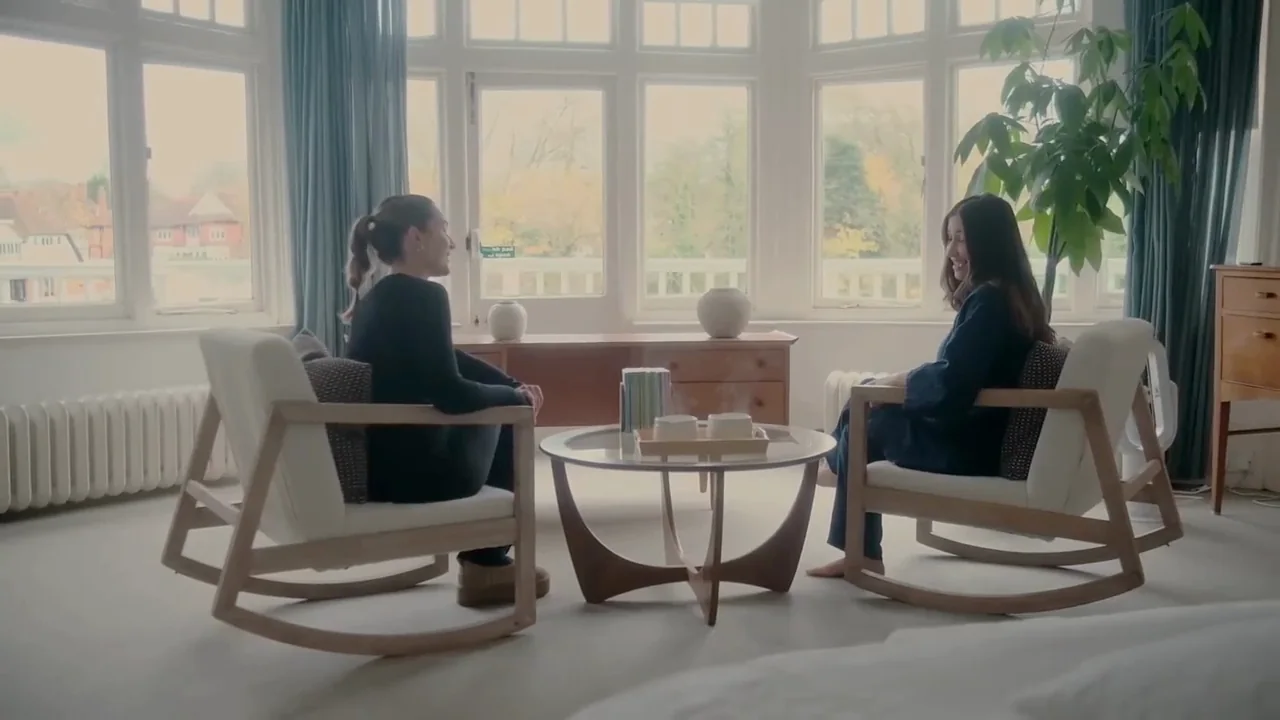
Sonnentag's account of the recovery paradox, that people under the greatest stress are often the least able to access genuine recovery, is a useful lens for thinking about why a short guided practice might feel disproportionately valuable when life allows for little else (Sonnentag, 2018). A ten-minute audio track asks almost nothing of a stretched schedule, which may explain much of its popularity independent of how strong the underlying evidence turns out to be. River Arts Club, the Observatory's sister site on the Thames, offers a studio and grounds built for exactly this kind of unhurried stillness, a quiet room facing the water rather than a screen. That setting may make a guided rest practice, or simply an unstructured quiet hour, considerably easier to actually experience without interruption. It does not, on its own, add anything to the evidence above about what such a practice does physiologically, and the Observatory is careful not to imply that it does.
What the Observatory observes
None of this is a case against trying a short guided rest practice; the trials above suggest it is very unlikely to cause harm and may, for some people, produce a real if modest short-term benefit. It is a case for holding the claims made about it to the same standard applied everywhere else in this publication. The Observatory's interest is in what a member actually notices when she tries something like this herself, observed honestly across repeated attempts rather than assumed from a single good session or dismissed from a single unremarkable one.
Members are invited to record, if they choose, when they tried a practice of this kind, what else was happening that day, how the following hour and the rest of the day felt, and whether anything resembling a pattern emerges across several attempts rather than one. This is not framed as a protocol proven to work, and Obsera does not diagnose, treat or monitor any condition; it is one small, optional entry in a longer personal record. Contribution of that record to the Observatory's wider, anonymised, consented dataset remains a separate and optional choice throughout. For more on why the Observatory favours evidence built over time rather than single studies presented as settled, see why women need longitudinal evidence; for the Observatory's account of moving from generic advice towards something more responsive to the individual, see from static advice to adaptive support.
The recording will keep saying the same calm words whether or not the science underneath them has caught up. What the trials actually show, so far, is a real, modest, short-lived effect in small studies, evidence worth taking seriously and evidence not yet large enough to justify most of what gets claimed about it. The honest version of this story is less dramatic than the marketing, and, in the Observatory's view, considerably more useful to anyone trying to work out what is actually worth ten minutes of a busy day.
References
- Time course of perceptual, cognitive, physical and physiological responses to a single non-sleep deep rest session in physically active young adults — Applied Psychology: Health and Well-Being (Boukhris et al.), 2026.
- Non-Sleep Deep Rest Relaxation and Virtual Reality Therapy for Psychological Outcomes in Patients with Coronary Artery Disease: A Pilot Randomized Controlled Trial — PMC (Wrzeciono, Cieślik, Kiper, Szczepańska-Gieracha & Gajda), 2024.
- The Recovery Experience Questionnaire: Development and Validation of a Measure for Assessing Recuperation and Unwinding From Work — Journal of Occupational Health Psychology (Sonnentag & Fritz), 2007.
- The Recovery Paradox: Portraying the Complex Interplay Between Job Stressors, Lack of Recovery, and Poor Well-Being — Research in Organizational Behavior (Sonnentag), 2018.
- Understanding and managing sleep problems during menopause — Women's Health Concern, the patient arm of the British Menopause Society, 2026.
- Menopause: identification and management (NG23), recommendation 1.5.24 — National Institute for Health and Care Excellence, 2024.
This article is written to inform, and does not diagnose, treat or advise on medication; always speak to a qualified clinician about your own health.
Observe your own patterns
The evidence above describes a pattern, not any one woman’s week. Membership gives you a way to notice your own, gentle daily observation read alongside research like this, over the weeks it actually takes to see a shape.
Become a member