River Arts Observatory
Understanding capacity in real life.
A female-first independent Observatory exploring how behaviour, biology, environment and context shape our capacity over time.
People change. Context changes. Capacity changes. Rather than simplifying that variability, we are building better ways to observe and understand it.
Beginning with women. Not exclusive to women.
What is an Observatory?
Capacity has been studied in fragments. We observe it over time.
The objective isn’t to give people another list of instructions. It is to help them understand their own patterns and the evidence around their choices so that they can exercise greater autonomy.
Observe
Observe your own patterns.
Notice
Notice what changes.
Understand
Understand the context.
Adapt
Adapt as circumstances change.
Choose
Choose with better evidence.
Less instruction. More understanding. Better choices.
Independent by design
No answer to sell you.
Evidence before certainty.
Consent before contribution.
Independence before influence.
The Observatory exists to help people understand evidence without needing to sell them the answer. We don’t manufacture supplements, beauty products or pharmaceuticals. We don’t want commercial sponsorship to determine what evidence someone sees. Our role is to observe, question and make robust evidence more understandable, including what is known, what remains uncertain and who funded the research.
The missing layer
Behavioural Intelligence.
Questionnaires capture a moment. Wearables capture particular signals. Clinical research answers specific questions under defined conditions. We are interested in another layer too: what people actually do and experience in the context of their everyday lives, and how those patterns change over time.
Behaviour, biology, environment and context, together, shape capacity.
The Observatory is developing ways to observe and understand these relationships longitudinally.
Where the question came from
The observations that started a bigger question.
Across our earlier work with more than 430 women, we began seeing recurring, but different, patterns across sleep, energy, overwhelm, attention and decision capacity. Rather than asking only “did people improve?”, we became interested in something more fundamental: why do people experiencing apparently similar demands respond so differently? That question helped create the Observatory and ultimately the adaptive profiling work behind Obsera.
Between April 2025 and April 2026, women on the Club’s Burnout to Capacity programme recorded how they felt on arrival and again afterwards. These are their own reports, not clinical measurements, and they do not establish cause. They are the same figures the Observatory has published, drawn here one person at a time.
Choose a measure, then compare before and after.
Sleep quality · Before the programme
443 women, before and after. Sleep quality rose by 1.67 on a four-point scale.
Each dot is one person; the brighter ones moved.
Adaptive profiling
One model doesn’t fit everyone.
Our early work identified recurring patterns in how depleted capacity can present, including Tired & Wired, Flat & Fatigued and Fragmented. These are not diagnoses, personality types or permanent labels. They are the beginning of an adaptive profiling model.
Obsera establishes an initial profile and continues observing patterns over time. As the person, circumstances and evidence change, the understanding should be capable of changing too.
The individual shouldn’t have to fit the model.
The model should learn to adapt to the individual.
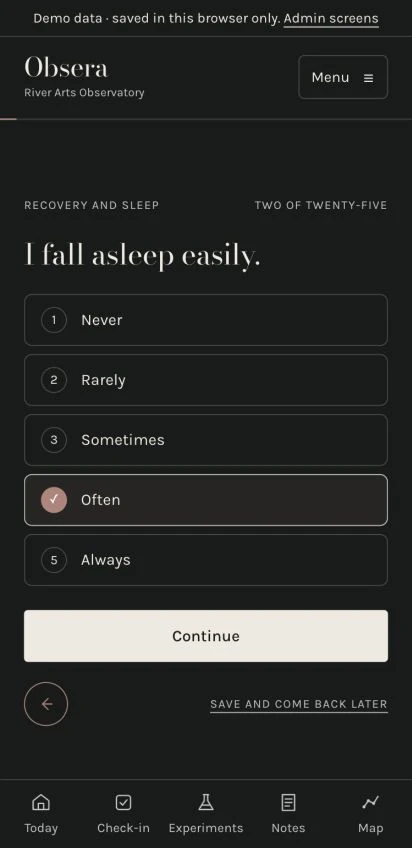
Obsera App Demo
Obsera, the digital expression of the Observatory
Obsera combines adaptive profiling with longitudinal self-observation to help an individual understand how her patterns change over time and in context. It is not designed to diagnose her or tell her what she should do. It is designed to help her notice, understand and make more informed choices.
Your fluctuations become information to understand, not something to judge.
Your understanding.
Your observations first help you understand your own patterns.
Our shared understanding.
With separate, informed consent and appropriate governance, anonymised observations may contribute to research intended to improve wider understanding.
One Observatory, many doorways
Obsera is where most Members begin, not where the Observatory ends.

The house on the river
The Observatory’s physical home is River Arts Club, on the Thames.
River Arts Club provides the setting and hospitality; River Arts Observatory provides the programme, technology and governance. No supplement sales, no sponsored answers: trust comes before influence.
From the Observatory
What we’re noticing lately.
The founding cohort
Become one of the founding women who shape the Observatory from the beginning.
Before Obsera opens to the world, a founding cohort of women help decide what it becomes: a mission-led membership, with digital and in-person options.
A founding voice in how Obsera develops · early access before the wider launch · lasting recognition within the founding cohort · choose the membership that suits you.